
Space Cowboys
MR Game Concept
Over a 20-week design project, I worked on developing a mini-game concept for Inter Astra, a science-fiction game by Milky Way Interactive. The project explored pervasive gaming and augmented reality (AR), covering the full design process from early research to concept development, prototyping and evaluation.
GOAL :
The goal was to design an engaging mini-game that meaningfully combines physical and digital interaction. By using AR and pervasive game mechanics, the experience aimed to encourage exploration, movement and learning, while fitting naturally into the science-fiction universe of Inter Astra.
RESULT :
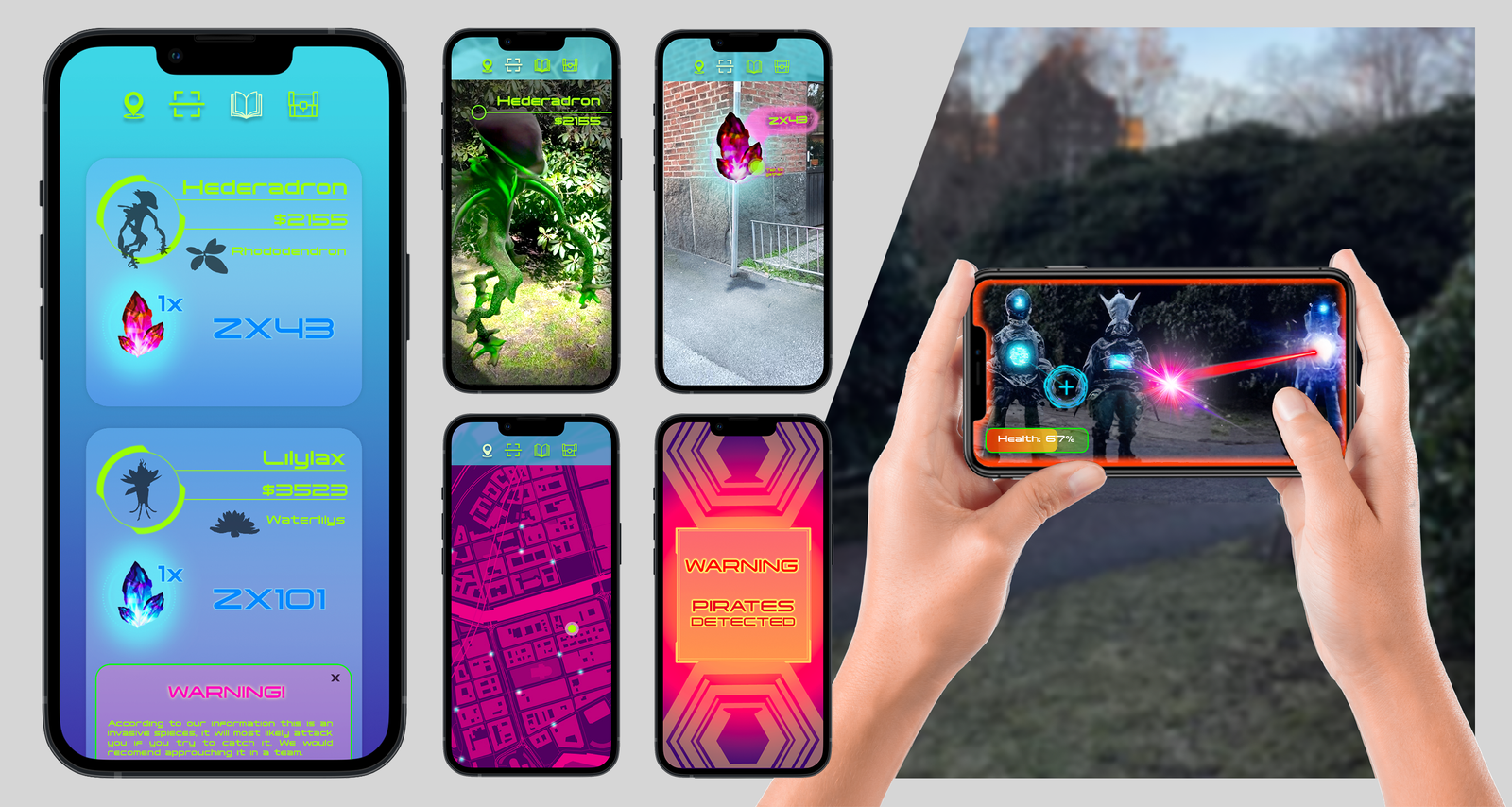
The project resulted in a validated game concept, Space Cowboys, supported by multiple prototypes and user tests. Through iterative design and evaluation, the concept demonstrates how AR-based gameplay can promote physical activity, learning and social interaction within an immersive and playful experience.
Year:
2024
Type of work:
MR Pervasive Game concept
Tags:
UX, UI, User testing, Pervasive Gaming, MR, 3D Modeling, UX Research, Prototyping, Storybuilding
Tools:
Figma, Adobe Aero, RealityComposer,
Process
Assignment & Vision
The assignment was to develop a mini-game for Milky Way Interactive’s science-fiction game Inter Astra, with a focus on pervasive gaming and augmented reality (AR). The project included the entire design process – from early research and conceptualization to prototyping and final evaluation.
The goal was to create an engaging and innovative game experience that combines the physical and digital worlds.
The vision was to create a game that not only entertains but also educates and promotes well-being. By integrating AR technology and strategic elements, I wanted to motivate players to explore their surroundings, learn about nature and take part in physical activity. The game should inspire long-term learning and community, while offering a unique and immersive experience.


Sprint 1 - Research & concept exploration
In the first sprint, a preliminary study was carried out to understand the science-fiction genre and current trends in pervasive gaming. Photo studies at various local sites were conducted to create an inclusive game environment. Two design concepts, Space Cowboys and The Megastructure, were developed based on sketches, collected data and analysis.
This sprint laid the foundation for the project’s continued development by establishing the game’s theme, aesthetics and core mechanics.
[See design concepts here (SVE)]
By combining inspiration from both science-fiction literature and current trends in game development, I was able to create two early, engaging concept proposals that are both challenging and immersive.
This experience broadened my understanding of pervasive gaming and AR technologies, and also deepened my insight into game design itself.
Sprint 2 - Prototyping & interaction exploration
The second sprint focused on further development and prototyping of “The Megastructure”, a game inspired by Snake but in 3D. Five different prototypes were created to explore light reflection, light control, digital AR environments and interaction between the player and the physical surroundings.
Through iterative testing and adjustments, important insights were gained about the design possibilities and user experience of the game. This sprint contributed to a deeper understanding of how players interact with both the physical and digital world.
Switching between analogue and digital prototypes provided valuable insight into how players respond in different contexts. Each prototype contributed to a deeper understanding of The Megastructure and its design potential. The iterative cycle of creating, testing and refining was crucial for improving interactivity and the overall player experience.


Sprint 3 - Concept evaluation & direction
In the third sprint, the Space Cowboys concept was developed further by exploring and reflecting on the aspects of “the real”, “the true” and “the ideal”. Through SWOT analysis, literature review and environmental analysis, the game’s potential to promote learning, physical movement and social interaction was identified.
Insights from this sprint helped balance creative and scientific approaches to create a game that is both entertaining and educational. The focus was on integrating user-centered methods to improve the game’s design and interactivity.
Sprint 4 - Testing & refinement
The final sprint focused on evaluating and refining Space Cowboys through scenario-based videos and interactive prototypes. Split-screen recordings were used to capture both the player’s physical actions and the on-screen AR experience.
User testing revealed the need for:
Clearer instructions
More intuitive interaction patterns
Adjusted graphic elements for better readability and feedback
These insights were incorporated into the final concept to improve usability and overall player experience.
Results
Final concept & demonstrator
The project resulted in a validated mini-game concept, Space Cowboys, supported by a demonstrator pitch, interaction flow and multiple prototypes. The final concept demonstrates how pervasive gaming and AR can be used to combine physical movement, learning and social interaction within a science-fiction context.
Key outcomes
Through iterative prototyping and testing, the final concept establishes:
A step-by-step introduction of game mechanics, improving learnability and reducing cognitive overload
Clearer feedback and visual indicators, enabling players to anticipate threats and react more effectively
A gameplay structure that encourages exploration, movement and engagement with the physical environment
Opportunities for collaboration and social interaction through shared objectives and team-based challenges
These outcomes were shaped directly by user testing and scenario-based evaluations.
Design learnings
The project reinforced the importance of an iterative and user-centered design process, where each cycle of design, testing and reflection informed concrete improvements. Early usability issues led to adjustments in onboarding, interaction patterns and feedback mechanisms, resulting in a more intuitive and engaging experience.
By combining creative exploration with scientific research and UX methods, the project shows how AR-based game design can balance entertainment with educational and well-being goals.
Reflection
The project reinforced the importance of an iterative and user-centered design process, where each cycle of design, testing and reflection informed concrete improvements. Early usability issues led to adjustments in onboarding, interaction patterns and feedback mechanisms, resulting in a more intuitive and engaging experience.
By combining creative exploration with scientific research and UX methods, the project shows how AR-based game design can balance entertainment with educational and well-being goals.